Croatia Passport Photo 35mm x 45mm requirements
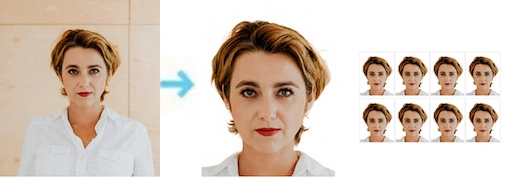
| Photo Size | Width: 35 mm, Height: 45 mm |
| Resolution (DPI) | 600 |
| Background color | White |
| Digital photo size | Width: 827 pixels, Height: 1063 pixels |
| Photo paper type | Glossy |
1. Dimensions and Layout
- Photo Size: 35 mm (width) x 45 mm (height).
- Head Size: The head (from the bottom of the chin to the top of the head) must occupy 70–80% of the photo height, which is between 32 mm and 36 mm.
- Centering: The face must be centered horizontally.
- Eye Distance: The distance between the centers of the eyes should ideally be 10 mm (minimum 8 mm).
2. Background and Quality
- Background: Must be a solid, light color (ideally light gray or white) with no patterns or shadows. There must be a clear contrast between the person and the background.
- Paper: The photo must be printed on high-quality, smooth, glossy, or matte photographic paper. It should not have any surface texture (like a honeycomb pattern).
- Clarity: The image must be sharp, in focus, and have natural color tones (no "red-eye"). It must be free of creases, scratches, or ink marks.
- Source: The official guideline states that photos should be taken by a professional photographer; photos from self-service booths (automatons) or retouched photos are generally not acceptable.
3. Pose and Expression
- Expression: Neutral expression with the mouth closed.
- Eyes: Eyes must be open, clearly visible, and looking directly at the camera. Hair must not cover the eyes.
- Position: Full frontal view (en face). Shoulders must be square to the camera; profiles or semi-profiles are not allowed.
4. Accessories and Exceptions
- Eyeglasses: Eyes must be clearly recognizable. Reflections on the lenses, tinted lenses, or sunglasses are prohibited. The frames must not cover any part of the eye.
- Head Coverings: Generally not allowed except for religious or medical reasons. If permitted, the face must be fully visible from the chin to the forehead, and the covering must not cast shadows on the face.
- Children: The child must be alone in the photo (no hands of parents visible). For babies, the eyes should ideally be open and the mouth closed, though some flexibility is often applied to very young infants.
5. Recency
- The photograph must not be older than six months.
References
Resources
Support
Secure Payments
Powered by PayPal |
© 2025 IDPhotoGo. All rights reserved