India Passport Photo 51mm x 51mm requirements
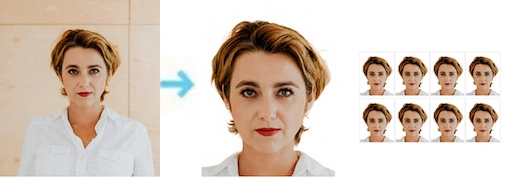
| Photo Size | Width: 51 mm, Height: 51 mm |
| Resolution (DPI) | 600 |
| Background color | White |
| Digital photo size | Width: 1205 pixels, Height: 1205 pixels |
| Photo paper type | Glossy |
Physical & Technical Specifications
- Size: The photograph must be exactly 2 inches x 2 inches (51 mm x 51 mm).
- Color: Photos must be in color with a continuous-tone quality.
- Background: Must be plain white or off-white.
- Contrast: The foreground and background must be easily differentiable; for example, wearing a white shirt against a white background is not acceptable.
- Paper Quality: Photos should be printed on thin photo paper or stock by a professional studio. Ordinary printer or Polaroid photos are not suitable.
Composition & Framing
- Face Coverage: The face (from the top of the hair to the bottom of the chin) must occupy 70% to 80% of the photo.
- Head Height: The physical height of the head should measure between 1.4 inches and 1.6 inches (35 mm to 40 mm).
- Position: The head must be centered and facing the camera directly (no tilting or "portrait style" turns).
- Expression: The expression should be natural and neutral with the mouth closed and eyes open and level.
Lighting & Appearance
- Lighting: Must be uniform and balanced to avoid shadows on the face or background.
- Skin Tone: Must appear natural. Over-exposed or under-exposed photos will be rejected.
- Eyeglasses: If worn, they must have thin, clear frames. There must be no flash reflection, glare, or frames obscuring the eyes. Tinted or dark lenses are prohibited.
- Head Coverings: Not permitted except for religious reasons. If worn, the facial features from the bottom of the chin to the top of the forehead and both edges of the face must be clearly visible.
Special Provisions for Children
- Infants: For babies under one year old, the eyes do not necessarily have to be open.
- Children Under 10: Requirements for head height and eye position are slightly relaxed.
- Environment: The child must be alone in the photo—no toys, chair backs, or other people should be visible.
Digital & Scanning Standards
- Resolution: Digital images should be at least 300 dpi and approximately 600 pixels in size.
- Clarity: The image must be in sharp focus without any pixilation, dot patterns, ink marks, or creases.
References
Resources
Support
Secure Payments
Powered by PayPal |
© 2025 IDPhotoGo. All rights reserved